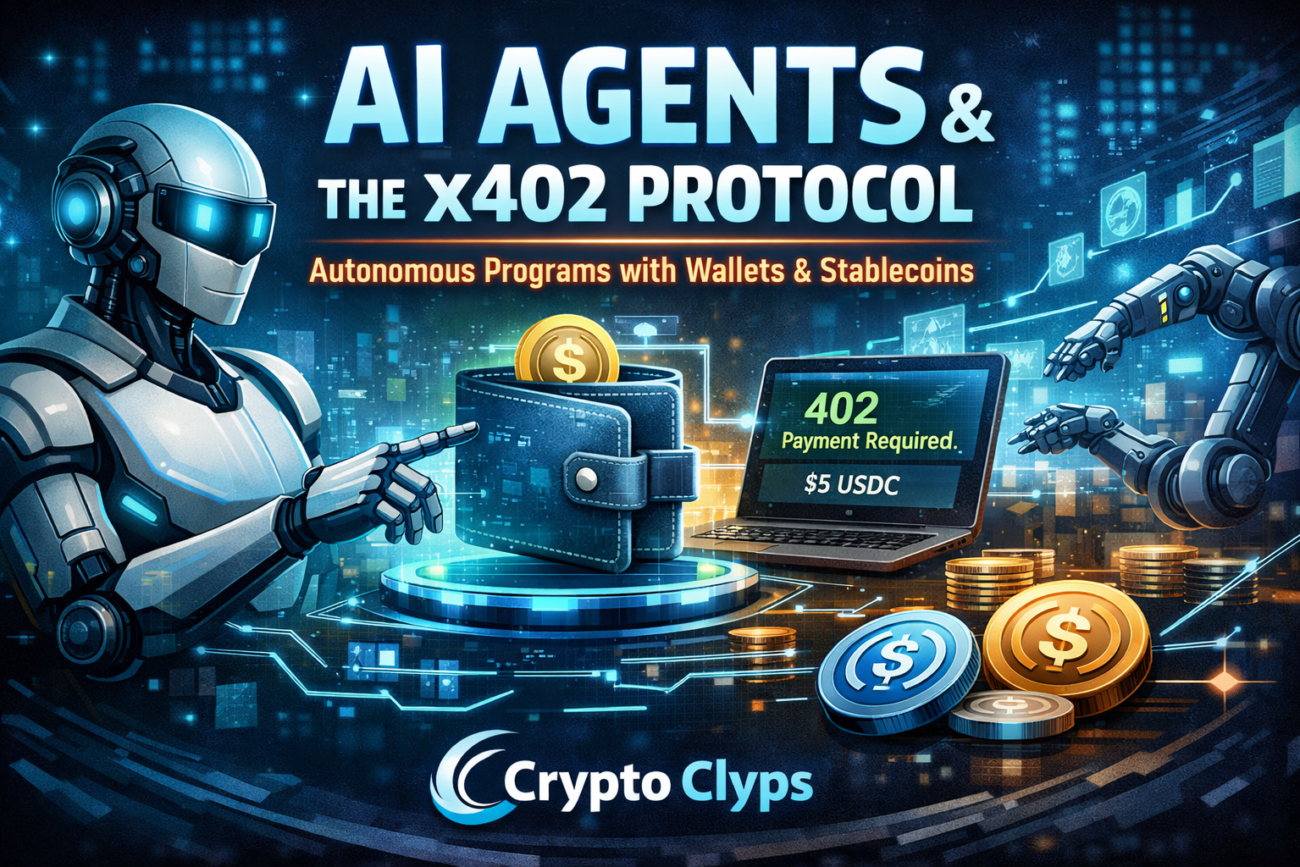
Introduction: When Software Becomes an Economic Entity
For decades, software has served as a passive tool—executing commands, processing data, and responding to user inputs. But a profound shift is underway. We are entering an era where software is no longer just a tool, but an autonomous economic participant. These systems—commonly referred to as AI agents—are increasingly capable of making decisions, executing tasks, and now, crucially, owning and spending money.
At the heart of this transformation lies a convergence of artificial intelligence and blockchain infrastructure. One of the most intriguing developments enabling this convergence is the emergence of protocols like x402, which allow AI agents to interact with digital services through programmable payments, often using stablecoins.
This evolution signals the birth of a new paradigm: machine-to-machine economies, where autonomous programs transact, negotiate, and operate with minimal human intervention. In this article, we explore how AI agents and the x402 protocol are reshaping digital commerce, the implications for industries, and the challenges that lie ahead.
What Are AI Agents?
AI agents are software systems designed to perceive, decide, and act in pursuit of defined objectives. Unlike traditional applications, which require explicit user instructions, AI agents can operate semi-independently or fully autonomously.
Key Characteristics of AI Agents
-
Autonomy – They can operate without continuous human oversight.
-
Goal-Oriented Behavior – They pursue objectives defined by users or systems.
-
Adaptability – They learn from data and adjust their actions accordingly.
-
Interactivity – They can communicate with other systems, APIs, and even other agents.
Examples range from simple automation bots to sophisticated systems capable of managing workflows, trading assets, or coordinating logistics.
However, until recently, AI agents lacked one critical capability: native economic agency. They could not directly pay for services, hold funds, or participate in financial ecosystems without human intermediaries.
That limitation is now disappearing.
The Missing Piece: Native Payments for AI
Imagine an AI agent tasked with completing a complex project—say, building a website. It might need to:
-
Purchase API access for design tools
-
Pay for cloud computing resources
-
Subscribe to data feeds
-
Hire another specialized agent
Traditionally, these steps would require human involvement—approving payments, managing subscriptions, and handling credentials.
This bottleneck severely limits the autonomy of AI systems.
To unlock true autonomy, AI agents need:
-
Wallets to store value
-
Payment rails to transact globally
-
Programmable money to execute conditional logic
This is where blockchain technology—and specifically stablecoins—comes into play.
Stablecoins: The Currency of Autonomous Systems
Stablecoins are digital assets pegged to fiat currencies like the US dollar. Unlike volatile cryptocurrencies, stablecoins offer price stability, making them suitable for everyday transactions.
Why Stablecoins Matter for AI Agents
-
Predictability – Essential for budgeting and automated decision-making
-
Global Accessibility – No reliance on traditional banking systems
-
Programmability – Can be integrated into smart contracts and APIs
-
Instant Settlement – Enables real-time machine-to-machine payments
For AI agents, stablecoins function as a universal medium of exchange, enabling seamless interaction across digital services.
But payments alone are not enough. What’s needed is a standardized protocol that allows services to request and receive payments from autonomous agents in a frictionless way.
Enter the x402 protocol.
Understanding the x402 Protocol
The x402 protocol is an emerging standard designed to enable pay-per-request interactions between clients (including AI agents) and services.
It builds on a familiar concept from the web: HTTP status codes.
The Origin of 402
In HTTP, the status code 402 Payment Required was reserved but never widely implemented. The x402 protocol revives this concept, transforming it into a functional payment mechanism for APIs and digital services.
How x402 Works
-
A client (e.g., an AI agent) requests a resource from a server
-
The server responds with a 402 Payment Required message
-
The response includes payment details (amount, currency, wallet address)
-
The client sends payment using a supported method (e.g., stablecoin)
-
The server verifies the payment
-
Access to the resource is granted
This interaction can happen programmatically, without human intervention.
Key Features of x402
-
Stateless Payments – No need for prior accounts or subscriptions
-
On-Demand Access – Pay only for what you use
-
Interoperability – Works across different services and platforms
-
Automation-Friendly – Designed for machine-to-machine communication
In essence, x402 transforms APIs into self-monetizing services that can interact directly with autonomous agents.
AI Agents with Wallets: A New Economic Primitive
The combination of AI agents and x402-enabled payments introduces a powerful new concept: software that can earn, spend, and manage money independently.
What Does It Mean for an AI Agent to Have a Wallet?
An AI agent with a wallet can:
-
Receive payments for services it provides
-
Pay for resources it needs
-
Allocate budgets based on goals
-
Optimize spending decisions
This transforms AI from a passive tool into an active participant in economic systems.
Example Use Case
Consider an AI agent managing a marketing campaign:
-
It analyzes performance data
-
Identifies underperforming ads
-
Purchases new ad creatives from a design API (via x402)
-
Pays for additional data insights
-
Adjusts budget allocations in real time
All of this can happen autonomously, with payments executed via stablecoins.
The Rise of Machine-to-Machine Commerce
With AI agents capable of transacting independently, we are witnessing the emergence of machine-to-machine (M2M) commerce.
Characteristics of M2M Economies
-
Continuous Operation – Transactions occur 24/7
-
High Frequency – Microtransactions at scale
-
Low Friction – Minimal human involvement
-
Dynamic Pricing – Real-time negotiation and optimization
Potential Applications
1. Data Markets
AI agents can buy and sell datasets in real time, paying only for the data they need.
2. API Economies
Developers can monetize APIs on a per-request basis, with instant payment settlement.
3. Autonomous Supply Chains
Agents representing different entities can coordinate logistics, procurement, and payments.
4. Decentralized Services
AI agents can interact with decentralized infrastructure—storage, compute, and bandwidth—paying per usage.
Why x402 Matters for Developers and Businesses
The x402 protocol introduces a new business model: programmable, usage-based monetization.
Benefits for Developers
-
No need to build complex billing systems
-
Instant revenue from API usage
-
Global accessibility without payment processors
Benefits for Businesses
-
Reduced friction in service delivery
-
New revenue streams from microtransactions
-
Enhanced automation capabilities
Benefits for Users
-
Pay only for what they use
-
No subscriptions or lock-ins
-
Greater transparency in pricing
Security and Trust Considerations
While the potential is enormous, the rise of autonomous agents with financial capabilities introduces significant risks.
Key Challenges
1. Key Management
AI agents must securely store and manage private keys.
2. Fraud and Abuse
Malicious agents could exploit services or drain resources.
3. Verification
Ensuring that payments are valid and not double-spent.
4. Governance
Who is responsible for an AI agent’s actions?
Potential Solutions
-
Hardware-secured wallets
-
Rate limiting and usage controls
-
On-chain verification mechanisms
-
Identity frameworks for agents
Regulatory Implications
The concept of autonomous economic agents raises complex regulatory questions.
Key Issues
-
Legal Status – Can an AI agent be considered a legal entity?
-
Liability – Who is responsible for its actions?
-
Compliance – How do agents adhere to KYC/AML requirements?
Governments and regulators are only beginning to grapple with these questions. The answers will shape the future of AI-driven economies.
The Competitive Landscape
Several projects and ecosystems are exploring similar ideas:
-
Blockchain-based identity systems
-
Decentralized AI marketplaces
-
Autonomous agent frameworks
However, x402 stands out for its simplicity and compatibility with existing web standards, making it a strong candidate for widespread adoption.
Challenges to Adoption
Despite its promise, the x402 protocol and AI agent economy face several hurdles:
1. Infrastructure Maturity
The ecosystem is still in its early stages.
2. Developer Adoption
Widespread use requires tools, documentation, and community support.
3. User Trust
People must feel comfortable delegating financial control to AI.
4. Interoperability
Different systems must work seamlessly together.
The Future: Autonomous Economies
Looking ahead, the implications are profound.
Short-Term (1–2 Years)
-
Early adoption by developers and startups
-
Experimental AI agents with limited budgets
-
Growth of pay-per-use APIs
Medium-Term (3–5 Years)
-
Widespread use of AI agents in business operations
-
Integration with enterprise systems
-
Emergence of agent marketplaces
Long-Term (5–10 Years)
-
Fully autonomous organizations
-
Machine-driven economies
-
New forms of digital labor
Conclusion: A New Layer of the Internet
The rise of AI agents and protocols like x402 represents a fundamental shift in how the internet operates.
We are moving from:
-
Human-driven interactions → Machine-driven ecosystems
-
Subscription models → Usage-based micropayments
-
Centralized control → Decentralized autonomy
In this new paradigm, software is no longer just a tool—it is a participant, capable of earning, spending, and making decisions.
The implications extend far beyond technology. They touch on economics, law, governance, and the very nature of work.
As AI agents gain financial autonomy, we are not just building smarter systems—we are creating a new class of economic actors.
And with that, the internet itself begins to evolve—from a network of information to a network of value, driven by autonomous intelligence.
